Authentication
Merchant Authentication
The Pay service uses header-based authentication with HMAC verification
to ensure that requests originate from an authorized merchant.
------------------------------------------------------------------------
Overview
Every request to the Pay service must:
- Include required authentication headers
- Provide a valid HMAC-SHA256 signature (
x-token) - Pass authorization checks performed by the Authorization service
If any validation fails, the request is rejected.
------------------------------------------------------------------------
Authentication Headers
All requests must include the following headers.
Required
x-public-key
Identifies the merchant account.
x-buyer-ip
Buyer IP address (IPv4 or IPv6).
x-date
Request timestamp in the following format:
Y-m-d\TH:i:s
Example:
2024-01-27T23:59:59
x-token
HMAC-SHA256 signature generated using the merchant's secretKey.
x-id
Calling service identifier.
x-source
Channel context:
shopcpstaffdirectlink
------------------------------------------------------------------------
Generating the x-token
To authenticate a request, generate a signature using the following
string:
secretKey + x-public-key + x-buyer-ip + x-date
Concatenate values exactly in this order. No separators.
------------------------------------------------------------------------
PHP Example
<?php

$json = '{
  "x-buyer-ip": "10.10.10.10",
  "x-date": "2024-01-27T23:59:59",
  "x-public-key": "aa46a835-36fa-4f75-ba3d-dc8785912345",
  "secretKey": "secret-key-test123123123abc"
}';

$data = json_decode($json, true);

$xToken = hash_hmac(
    'sha256',
    $data['secretKey'] .
    $data['x-public-key'] .
    $data['x-buyer-ip'] .
    $data['x-date'],
    $data['secretKey']
);

echo $xToken;
Authorization procedure
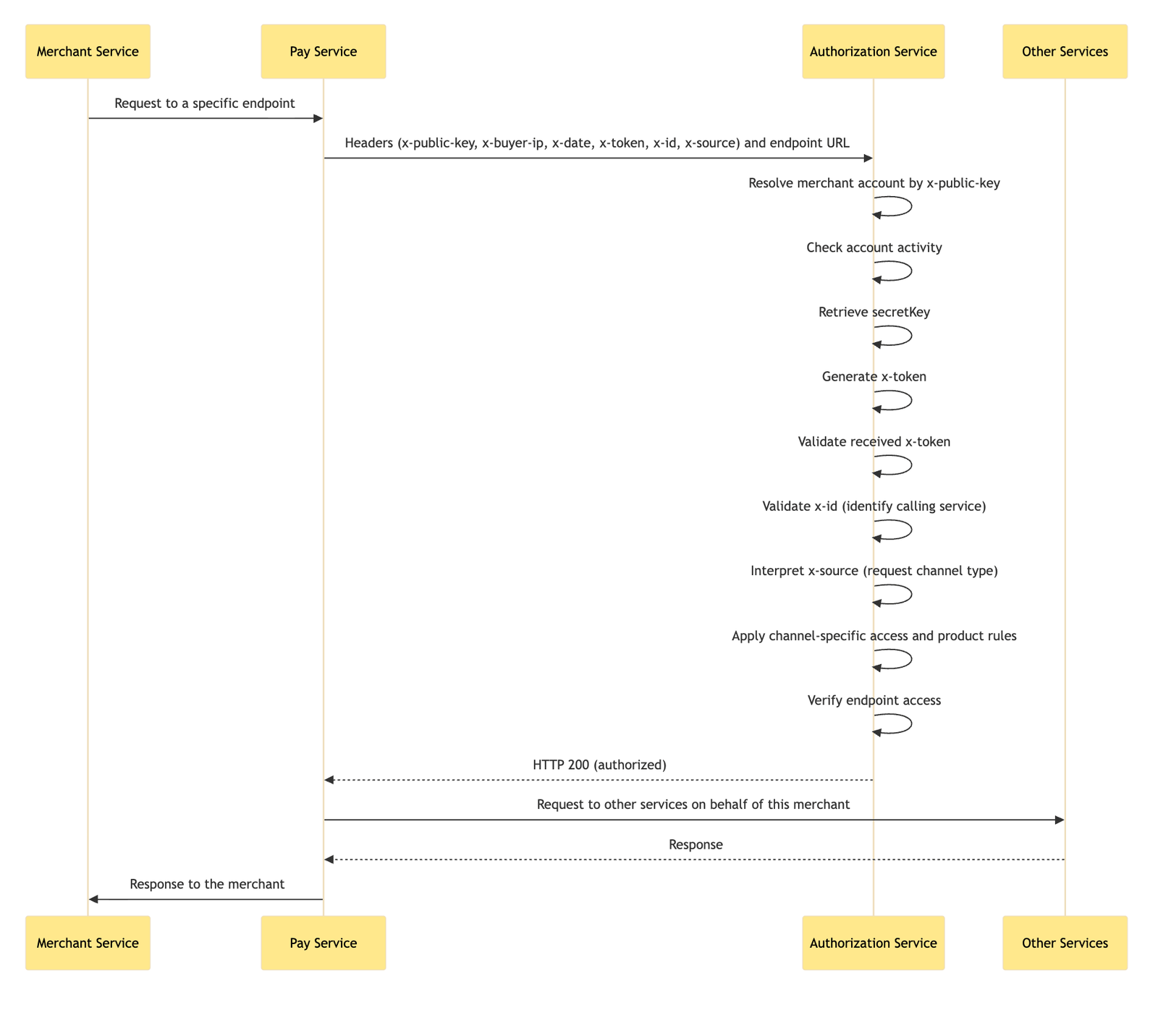
- The merchant’s service sends a request to a specific Pay service endpoint.
- When the Pay service receives the request, it takes the headers from the request
(x-public-key, x-buyer-ip, x-date, x-token, x-id, x-source) as well as the endpoint URL and forwards them to the Authorization service.
- The Authorization service validates the received data:
a. Merchant resolution
- Based on the received
x-public-key, determines the merchant account; - Checks that the account is active;
- Obtains the account
secretKey.
b. Token generation
- Generates an
x-tokenfrom the received data using the same algorithm as the merchant.
c. Token comparison
- Compares the generated
x-tokenwith the one received from the Pay service.
d. x-id validation (identify calling service)
- Extracts the
x-idheader; - Checks whether such a service exists in the access configuration;
- Checks whether this service is allowed to call the specific endpoint;
- If access is missing — returns 403 Forbidden.
e. x-source processing (request channel type)
- Reads
x-source; - Determines the channel context (
shop/cp/staff/directlink); - Configures further business logic based on the channel;
- If the type is incorrect or not allowed — returns 400 Bad Request or 403 Forbidden.
f. Endpoint access
- Checks the merchant account’s access to the requested endpoint.
g. Success response
- Sends 200 OK status with the merchant code back to the Pay service.
- The Pay service receives the
200status and sends the request to other services on behalf of this merchant. - The Pay service returns the response to the merchant.
Authorization flow diagram